By Emily Green
TIJUANA, June 7 (Reuters) - Iran’s national soccer team arrived in Tijuana early on Sunday ahead of three World Cup matches in the United States, amid tensions that have turned the world’s biggest sporting event into a soft-power contest between the warring countries.
The squad touched down shortly after 5 am (1200 GMT) in the Mexican city, across the border from San Diego, after an overnight flight from Turkey where they have been training for the past three weeks.
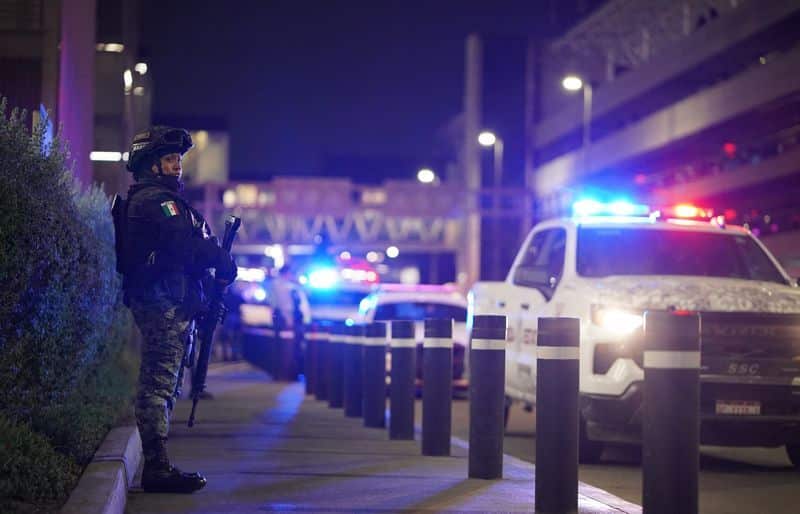
As the team’s bus pulled away from Tijuana airport, it paused briefly so members of the federation could wave to about 20 fans holding Iranian flags. A cordon of military and police escorted the team from the airport to their hotel.
Soccer is virtually a religion in Iran, a national pastime beloved by people across the political spectrum. But for Iran’s team, the tournament has been marred by fraught politics at home, the war with the U.S., and tensions over whether they would actually be able to set foot on U.S. soil to play their games.
Even their presence in Tijuana is politically tinged. The Iranian federation negotiated at the last minute to move the team’s base camp from Arizona to Mexico, due to uncertainty over whether they would be granted visas and a growing feeling in Iran that the squad’s presence in the U.S. should be kept to a minimum, Iran’s ambassador in Mexico, Abolfazl Pasandideh, told Reuters.
Iran’s coach Amir Ghalenoei told FIFA that the team ideally would have arrived in Tijuana last week in order to adapt to the time difference.
“Normally, in tournaments like this, humanitarian and ethical considerations should come before technical matters, and I believe those considerations were not extended to us,” he said after arriving at Tijuana airport.
Iranian defender Ehsan Hajsafi said the team has suffered “very difficult circumstances” since the U.S. and Israel attacked Iran in February but that the players are in excellent physical condition and “fully ready” for the tournament.
Iran are scheduled to play their first two Group G games near Los Angeles, against New Zealand on June 15 and Belgium on June 21, and then face Egypt in Seattle on June 26. Iran and the U.S. could meet in the round of 32 if both teams come second in their groups.
PRESSURE ON PLAYERS
This is the first World Cup since its inception in 1930 in which a host nation is set to receive a country it is at war with.
But the U.S. tensions are just one of several factors that have turned the World Cup into a political battleground for the Iranian team.
Widespread protests that erupted late last year, calling for an end to clerical rule, culminated in a sweeping crackdown that killed more than 2,000 people in the deadliest unrest since Iran’s 1979 Islamic Revolution. The U.S. and Israel then attacked Iran on February 28, sparking a months-long war that continues.
Iran’s soccer team were under pressure from all sides, said Abbas Milani, director of Iranian studies at Stanford University.
“It has become a lose-lose for the players,” Milani said. “There are pressures on players not to play with the team, pressure to show comity with the people, and the athletes are just there to play soccer,” he said.
During the 2022 World Cup in Qatar, Iran’s team were both cheered and jeered after refusing to sing the national anthem, which was viewed as an act of solidarity with anti-government protesters back home. Since then, the pressures on the team had only increased, Milani said.
VISA DRAMA
After weeks of uncertainty, the U.S. awarded visas to all the players on Friday, just 10 days before their first match.
But several members of the Iranian squad were not given visas, including “key managerial and administrative members,” according to Iran’s football federation, which accused the U.S. of breaching its host obligations and violating FIFA regulations.
Pasandideh, the Iranian ambassador, said 15 of the 70 members of the party who arrived in Tijuana on Sunday had not been given visas to enter the U.S.
FIFA did not respond to a request for comment about the dispute.
An official with the U.S. State Department told Reuters on Friday that the administration had issued “the visas necessary for Iran to compete in the World Cup, including for athletes and necessary support staff.” The official added: “We will not allow the Iranian team to abuse this system to sneak terrorists into the U.S. under false pretenses.”
Tonatiuh Guillen, who ran Mexico’s national immigration agency between 2018 and 2019, said Mexico’s willingness to host the Iran squad is a message of “solidarity at a moment of emergency.”
(Reporting by Emily Green; editing by Tomasz Janowski, Clare Fallon and Pritha Sarkar)